Route-Tracker | Published 28.3.2026 | Updated 20.10.2026
A driving logbook or other reliable documentation is required in six situations. Driving log can be manual or electronic.
This page is for general guidance only and does not constitute tax or legal advice. Always check for the most up-to-date guidance. tax.fifrom the website.
When you drive your own car to work, your employer can pay you a tax-free mileage allowance. A travel invoice is required for this, and the journeys must be driving log. In 2026, the maximum tax-free amount is 55 cents/km. The same driving log supports the deduction of an entrepreneur's business activities when he drives his own car to work.
55 cents/km
tax-free maximum amount 2026
25 €
partial daily allowance (over 6 hours)
54 €
full-time allowance (over 10 hours)
The travel invoice may also include a daily allowance. The partial daily allowance is €25 (travel over 6 hours) and the full daily allowance is €54 (travel over 10 hours). The temporary workplace must be more than 15 km away from the permanent workplace or home. In addition, it must be more than 5 km away from both.
2Company car as a company car (Oy)
If an employee can use the company car for private trips, this creates a taxable car benefit. Driving log indicates that the car is not used for private trips. In this case, no car benefit arises.
The journey from home to work is not a work trip and is not reported as a work trip in the driving logbook.
3Reducing the tax value of car benefits
The monthly value of the car benefit is based on the assumption that private driving is 1,500 km per month, or 18,000 km per year. If private driving is consistently less, a driving log can provide a more favorable, kilometer-based value. The number of kilometers of private driving is sufficient.
1,500 km
private driving per month (default)
18,000 km
private driving per year (default)
The employee reports the kilometres driven on his tax return and claims a reduction in the value of the benefit. He keeps the driving log himself and only submits it to the Tax Administration upon request. If the car is used by more than one person, the calculation of the value always requires a driving log or other reliable report. The chosen calculation method must be followed systematically.
4Self-employed person's car
An entrepreneur's car is either a company car or a private car. The limit is the proportion of business trips. The car belongs to the company when it was purchased for business purposes and more than 50% of the kilometers driven are business trips. In that case, the car costs can be deducted in the company's tax return. Costs include, for example, fuel, maintenance and insurance.
over 50%
mileage for work trips → the car belongs to the company
20% private rides
→ 20% of expenses remain undeducted
The share of private trips in expenses cannot be deducted. For example, if 20% of the trips are private trips, 20% of the expenses will not be deducted. A trip from home to the company's office is not a business trip. Driving log indicates that the 50% limit is met and tells you how much of the expenses will not be deducted.
It is advisable to keep a driving log from the very beginning of the operation.
5VAT deduction for vans and other commercial vehicles
A company can deduct VAT on the purchase price and operating costs (fuel, maintenance, insurance) of a van. The condition is that the car is used in a business that qualifies for the deduction. If the car is also used for private purposes, the deduction is only available for the business use portion.
Driving log indicates this share. The Tax Administration requires a driving log or other reliable report even when the car is used only for business purposes. Based on the driving log, the company will also adjust the deduction made from the purchase price in subsequent financial years if the share of private use changes. Without a reliable report, the deduction may be invalid.
6VAT deduction for a passenger car
The rule is stricter for passenger cars. You can only claim a deduction if the car is used exclusively for purposes that qualify for a deduction. Even minor private use removes the right to deduct from the entire car. You can use a driving logbook to prove that there is no private use. But be prepared for the fact that the tax authorities may require additional evidence.
Even minor private use removes the right to deduct from the entire passenger car.
Taxation of travel expenses between home and workplace
Trips between home and work are not considered work trips. They are counted as private trips in the driving logbook.
However, you can deduct the costs of travel between home and work in your personal tax return to a limited extent, depending on the cheapest means of transport. The deduction is a maximum of 7,000 euros per year and the deductible is 800 euros.
maximum €7,000
reduction per year
800 €
deductible
What to enter in the driving logbook
Driving log is kept separately for each vehicle. Working hours are recorded daily:
start and end time of the ride
starting and ending point and, if necessary, route
odometer reading at the beginning and end
length of trip
purpose of driving
car user
In addition, the total number of kilometers driven during the tax year must be disclosed.
Manual or electronic
Manual
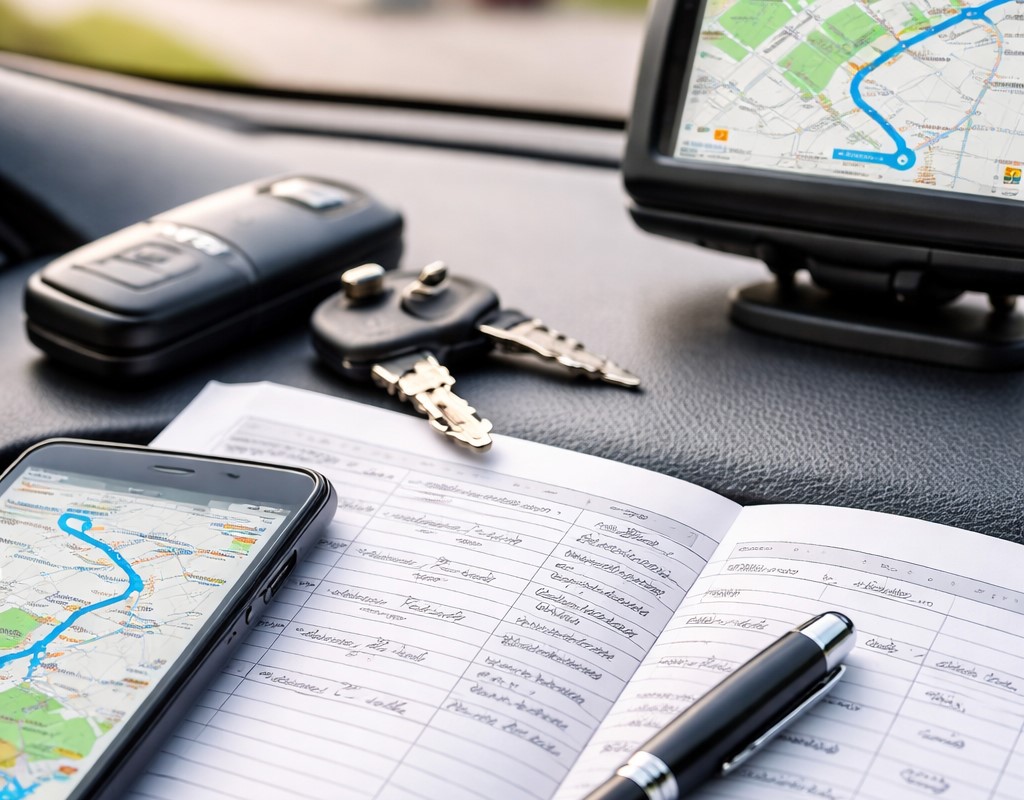
Manual driving log are recorded manually in a notebook or table, for each run separately.
Electronic
Electronic automatically records times, locations and kilometers from the device.
Any other report will also work if it contains the same information.
Route-Tracker as a driving log
Route-Tracker saves driving routes, dates and times in the background. Tracker reads the odometer readings from the car's OBD bus and calculates the distance. Use the Work trip button to mark the trip as work or private. Private trips are saved, but they are only visible with the driver's personal ID. The user is identified by a user ID or driver ID. The program produces driving logs and daily allowance and travel invoice breakdowns.
Information required by the tax administration and the activities of Route-Tracker
Information required by the tax administration
Route-Tracker's
Start and end time of the ride
stored in the background (dates and times)
Starting and ending point, route
saved in the background (routes)
Odometer reading
read from the car's OBD bus
Length of trip
tracker counts
Purpose of the ride
with the work trip button for work or private travel
Car user
username or driver identification
Travel expenses and daily allowance
the program produces daily allowance and travel expense breakdowns
The company's driving logs are kept as accounting records for at least 6 years.
Frequently asked questions about the driving logbook
Is a driving logbook required for mileage reimbursement?
When you drive your own car for work and your employer pays tax-free mileage allowance, a travel invoice is required and the journeys must be driving log. In 2026, the maximum tax-free amount is 55 cents/km.
How much will the daily allowance be in 2026?
The partial daily allowance is €25 (travel over 6 hours) and the full daily allowance is €54 (travel over 10 hours). The temporary workplace must be more than 15 km away from the permanent workplace or home and also more than 5 km away from both.
When does a company car become a car benefit?
If an employee can use a company car for private trips, this creates a taxable car benefit. Driving log indicates that the car is not used for private trips. In this case, no car benefit arises. The trip from home to work is considered private travel.
How can the tax value of a car benefit be reduced?
The monthly value of the car benefit is based on the assumption that private driving is 1,500 km per month, or 18,000 km per year. If private driving is consistently less, a driving log can be used to obtain a more favorable, kilometer-based value. The number of kilometers of private driving is sufficient. The employee reports the kilometers driven on his tax return and requests a reduction in the value of the benefit.
When does a sole proprietor's car belong to the company?
A car belongs to the company when it is purchased for business purposes and more than 50% of the kilometres driven are for work. In that case, the car costs can be deducted in the company's tax return. A journey from home to the company's premises is not a work journey.
How much of the expenses will not be deducted if the car is used for private purposes?
The share of private trips in the expenses cannot be deducted. For example, if 20% of the trips are private trips, 20% of the expenses will not be deducted.
Can the VAT on a van be deducted if the car is also used for private purposes?
If the car is also used for private purposes, the deduction is only available for the business use portion. Driving log indicates this portion. The Tax Administration requires a driving logbook or other reliable report even when the car is used only for business purposes.
Can the VAT on a passenger car be deducted if the car is for private use?
No. You can only claim a deduction for a passenger car if the car is used exclusively for purposes that entitle you to a deduction. Even minor private use will remove the right to deduct from the entire car.
Can travel expenses between home and work be deducted from taxes?
Travel between home and work is not considered work and is counted as private travel in the driving logbook. However, you can deduct the costs of travel between home and work in your personal tax return to a limited extent, depending on the cheapest means of transport. The deduction is up to 7,000 euros per year and the deductible is 800 euros.
What is entered in the driving log?
Driving log is kept separately for each vehicle. The working hours are recorded daily, including the start and end time of the journey, the start and end location, and if necessary, the route, the odometer reading at the beginning and end, the length of the journey, the purpose of the journey, and the vehicle user. In addition, the total number of kilometres driven during the tax year must be stated.
Can driving log be electronic?
Yes. Driving log can be manual or electronic. Any other form of reporting is also acceptable if it contains the same information.
How long is driving log stored?
The company's driving logs are kept as accounting records for at least 6 years.